
Ultimate Guide to LED Advertising Screens: Boost Your
A lot of homeowners arrive at the same moment from different directions. The pool is finished. The outdoor kitchen is dialed in. The outdoor lighting looks sharp after dusk. Then the question lands: why does the entertainment experience still feel temporary?
That usually happens when the visual centerpiece is still being treated like a patio accessory instead of part of the architecture. For a luxury estate, a large-format LED display isn't just a bigger television. It's a permanent visual system that has to perform in sun, weather, and real daily use while still respecting sightlines, materials, and the rhythm of the property.
Architects, builders, and discerning homeowners also run into a second problem. Most information about LED advertising screens is written for retail stores, stadiums, or roadside billboards. That's useful up to a point, but it doesn't answer the questions that matter in a high-end residential project: how close people will sit, how bright the screen needs to be at different times of day, what the structure has to support, how the control system should behave, and what ownership looks like over time.
Table of Contents
- An Introduction to Architectural LED Displays
- Beyond the Billboard Redefining Screens for Luxury Spaces
- Decoding the Technology Pixel Pitch Brightness and Performance
- Selecting the Right Screen for Your Environment
- Structural Integration and Installation Realities
- Content Management and Smart Home Integration
- Understanding the Investment Cost ROI and Long-Term Value
- Frequently Asked Questions About Residential LED Walls
An Introduction to Architectural LED Displays
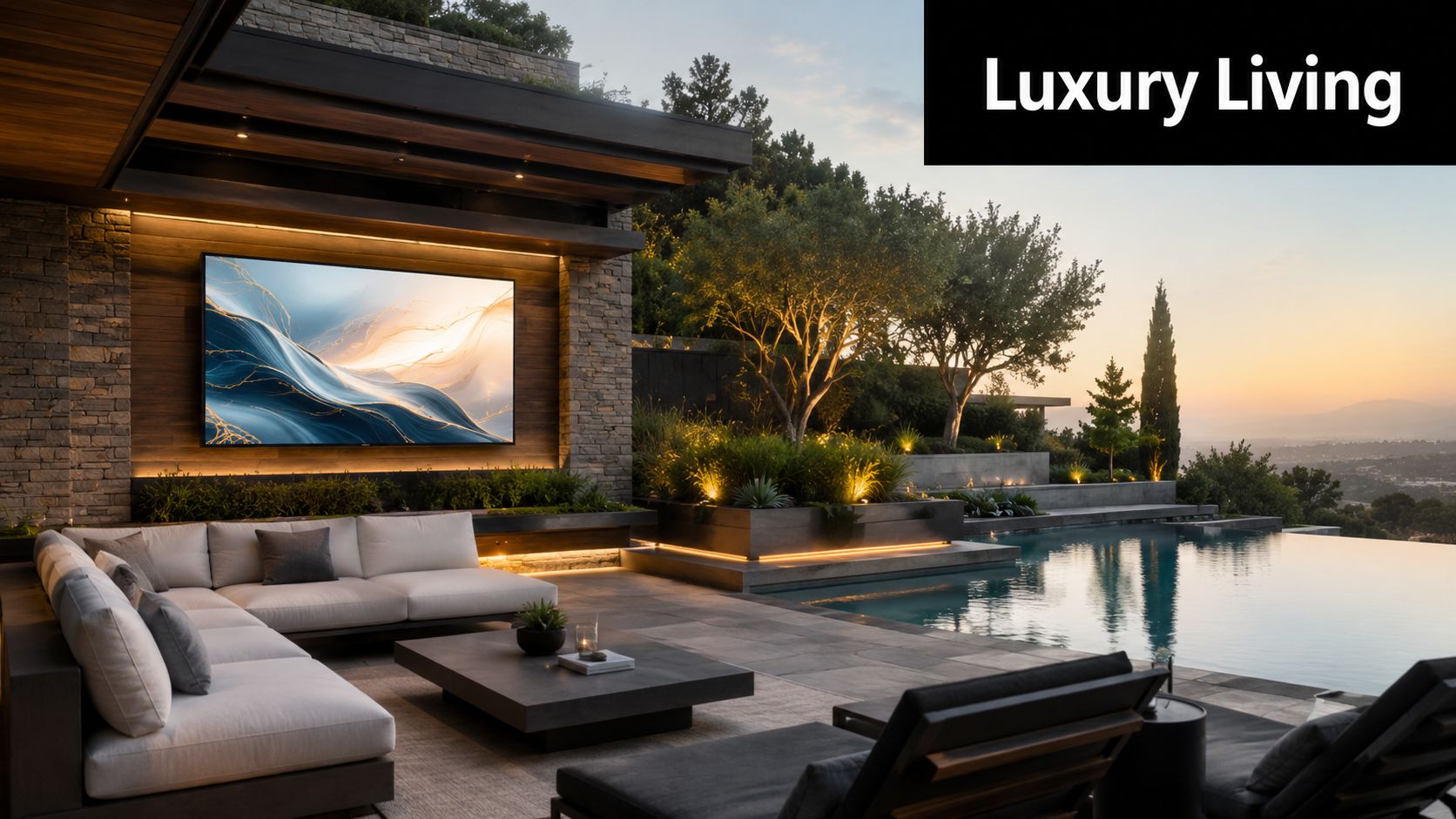
Luxury clients usually aren't asking for an LED billboard. They're asking for a property that performs at the same level as the rest of the design. That means movie nights that don't disappear when the sun is still up. It means a pool terrace that can host a championship game without everyone squinting. It means the screen looks intentional when it's off, not like a commercial panel dropped into a residential setting.
The useful term here is architectural LED display. It shifts the conversation away from commodity electronics and toward material integration, engineering, and lifestyle use. In practice, that's the difference between an oversized screen that feels bolted on and a display system that belongs to the estate.
For homeowners and design teams sorting through the options, the fastest way to get grounded is to review a serious planning resource such as the YOLO TV Learning Center. The language matters less than the process. Good projects begin with viewing patterns, orientation, structure, and control requirements, not with a random screen size selected from a brochure.
Executive summary
A permanent residential LED system succeeds when four decisions line up:
- Technology selection: The right pixel pitch, brightness profile, and refresh performance for where people will sit.
- Environmental planning: Sun exposure, humidity, dust, salt air, and seasonal use determine what works and what fails early.
- Structural integration: Mounting, foundations, power routing, and data pathways have to be coordinated before finish materials lock the team in.
- Investment analysis: Permanent systems should be judged on ownership value, reliability, serviceability, and architectural contribution, not just acquisition price.
Practical rule: If the screen discussion starts with size alone, the project is already drifting off course.
What to know before specifying a screen
The clients who make the best decisions tend to ask better questions up front.
What kind of experience do we want? A sports terrace, a cinematic lawn, a pool pavilion, and an indoor-outdoor lounge all call for different screen behavior.
How close will people be? Close viewing changes everything. Fine pitch matters more than raw size when the seating zone is intimate.
What does the site do during the day? Morning glare, reflected water, western sun, and bright paving all affect perceived contrast.
How will the display disappear into the design? In top-tier projects, the off-state matters almost as much as the on-state.
Beyond the Billboard Redefining Screens for Luxury Spaces
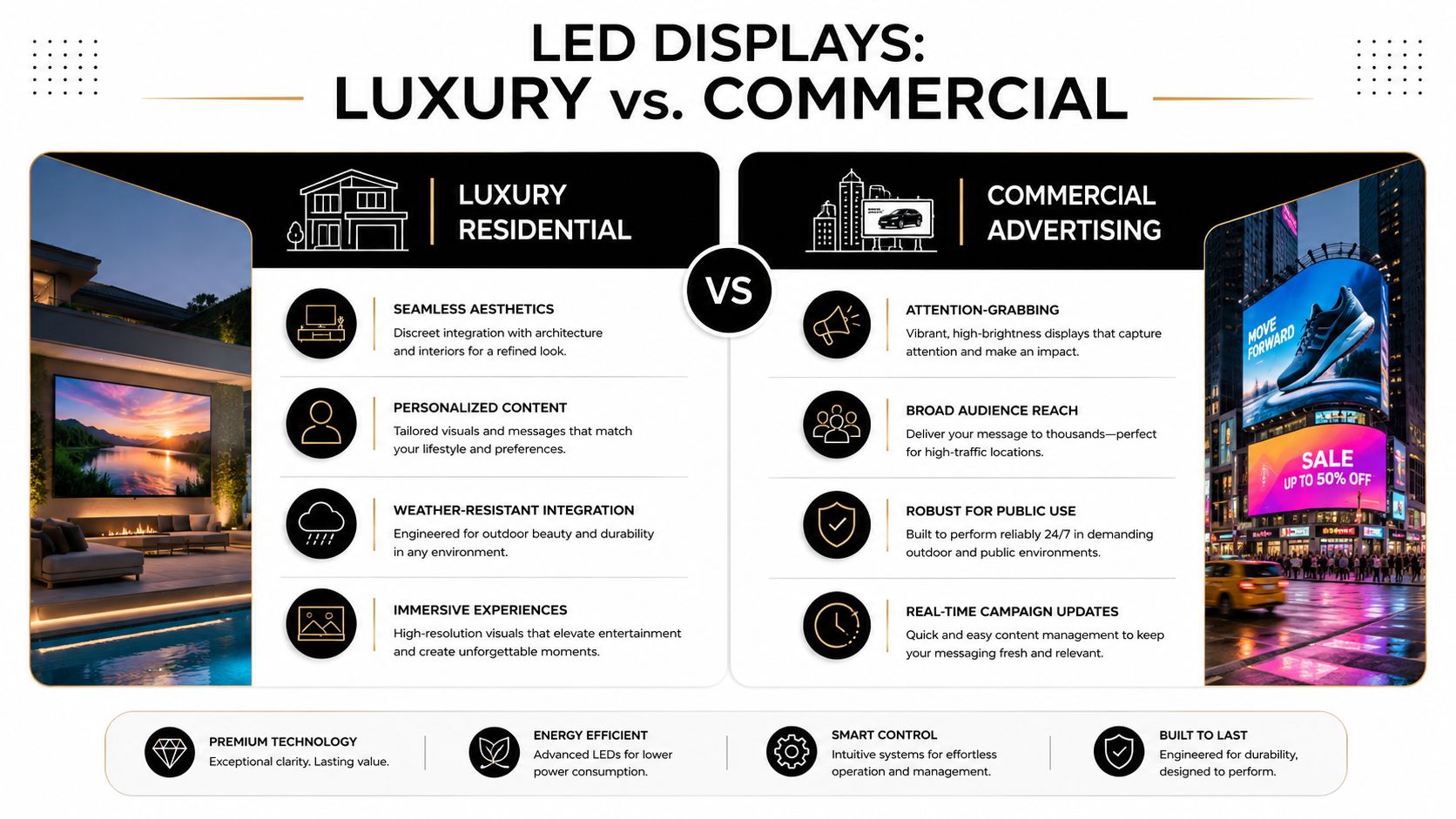
The phrase LED advertising screens can send homeowners in the wrong direction. It suggests Times Square, roadside signage, and commercial messaging. This technology, however, offers broader applications. The same core direct view LED technology trusted in public venues has become a logical fit for private estates because it solves one problem consumer displays never fully solved: large-scale visibility in demanding conditions.
That shift isn't theoretical. The Grand View Research LED modular display analysis states that the global LED modular display market was estimated at $7.53 billion in 2023 and is projected to reach $17.84 billion by 2030, growing at a 13.7% CAGR from 2024 to 2030. The same source ties that growth to deployment in high-profile venues, a trend now extending into the luxury residential sector.
Why commercial technology belongs in private estates
A private estate often places harder expectations on a screen than a public ad install.
A commercial site may only care that the message is visible from a distance. A luxury residence cares about much more. The image has to look refined from seating areas. The structure has to suit architecture rather than dominate it. The system has to play well with landscaping, lighting, pools, outdoor audio, and smart home controls.
That is why direct view LED is replacing the old mental model of "big outdoor TV" on many premium projects. It offers modular scale, design flexibility, and a more architectural presence.
In luxury settings, the question isn't "Can we mount a screen here?" It's "Can this become part of the property without compromising the property?"
Where residential projects go wrong
The most common mistake is importing commercial logic without residential judgment.
- They overspec for spectacle but underspec for comfort. A screen can be bright enough for daytime use and still feel harsh after dark if control logic isn't handled well.
- They buy around a single wow moment. The owner sees a giant display in a showroom, then discovers their own seating distance and sun orientation demand different choices.
- They ignore aesthetics when the screen is off. Luxury design doesn't end when content stops playing.
- They treat installation like AV trim work. Permanent LED belongs in early architectural coordination, not at the end of the build.
A gallery review is often more revealing than a product sheet because it shows how screens sit within real materials, real hardscape, and real sightlines. That's why teams often benefit from looking at a finished project gallery before locking in direction.
Decoding the Technology Pixel Pitch Brightness and Performance
Specs can sound abstract until you're sitting ten feet away from the finished wall or staring into full afternoon sun. Then they become painfully real. For residential projects, three terms drive most of the outcome: pixel pitch, brightness, and refresh rate.
Pixel pitch is a viewing distance decision
Pixel pitch is the distance between adjacent LED lamps, measured in millimeters. Smaller numbers mean tighter spacing and finer detail. In a luxury setting, I usually explain it like fabric. Fine linens look refined up close because the weave is tighter. Coarser fabric looks acceptable from across the room but not from the sofa.
The technical rule is straightforward. Dynamo LED Displays' parameter guide notes that pixel pitch directly determines image clarity and optimal viewing distance. It identifies 0.9–2.5 mm as standard for indoor MicroLED applications that support close viewing, and it also notes that premium outdoor systems use 6,000+ nits brightness and 7,680 Hz refresh rates to preserve motion stability in direct sunlight.
Brightness has to match the sun
Homeowners often hear one brightness number and assume that's enough. It isn't. Outdoor brightness only makes sense in relation to orientation, reflections, surrounding materials, and the time of day the space is used.
For a poolside screen, brightness is fighting more than sky light. It's also fighting reflected glare off water, pale stone, metal finishes, and glass. That's why outdoor large-format screens require a very different spec mindset than media room walls.
Refresh rate affects motion and camera performance
Refresh rate is one of those specs that people ignore until they watch fast sports, pan-heavy film scenes, or content being captured on a phone. Then poor performance shows up immediately as flicker or instability.
At the high end, 7,680 Hz matters because it keeps motion cleaner and avoids the cheap-screen look that becomes obvious in premium spaces. It also helps when guests record events near the display.
Indoor vs. Outdoor LED Display Specifications
| Specification | Luxury Indoor (e.g., Media Room) | Luxury Outdoor (e.g., Poolside) |
|---|---|---|
| Primary priority | Fine detail at close viewing | Visibility in sunlight and weather exposure |
| Typical pixel pitch direction | 0.9–2.5 mm for close viewing applications | Larger pitch chosen according to viewing distance |
| Brightness approach | Lower output suited to controlled ambient light | 6,000+ nits for demanding outdoor visibility |
| Refresh rate target | High refresh supports premium motion quality | 7,680 Hz helps eliminate flicker and stabilize motion |
| Design emphasis | Flush architectural finish, refined indoor surfaces | Ruggedized enclosure strategy, outdoor integration, drainage and service access |
A good specification process doesn't start with the biggest panel available. It starts with the owner's primary seat, the daytime lighting pattern, and how the display will be used on an ordinary weeknight.
For teams that want a tighter specification discussion before scheduling drawings, a manufacturer packet such as the requested brochure from YOLO TV can help compare module behavior, mounting paths, and integration options without reducing the decision to marketing language.
Selecting the Right Screen for Your Environment
The right screen for a Scottsdale courtyard isn't automatically the right screen for a shaded mountain terrace or a coastal Florida lanai. Site conditions decide more than most buyers expect.
Start with the site not the screen size
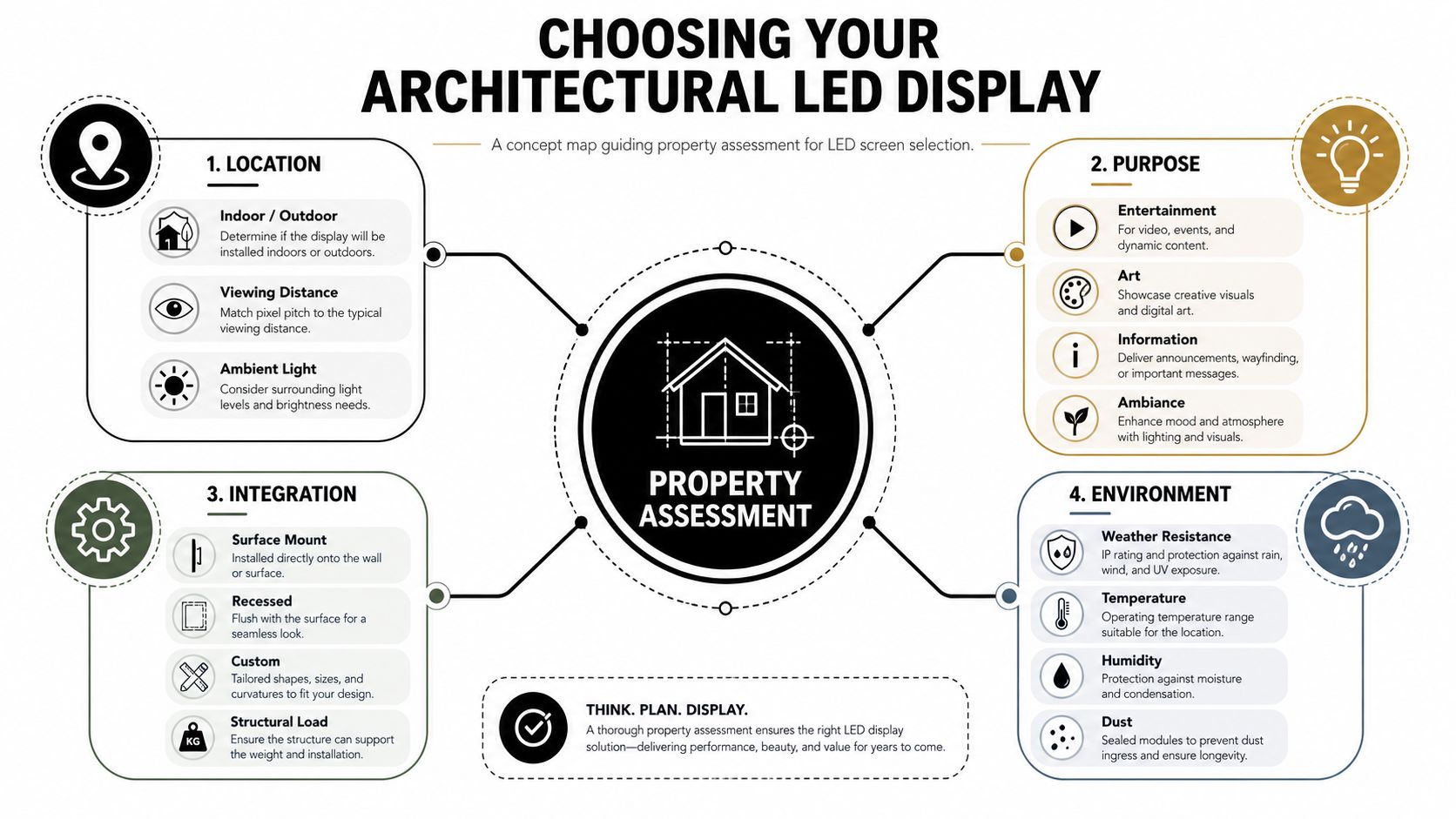
A practical first step is to identify the primary viewing distance and the secondary social zones. On estate projects, people rarely watch from one fixed chair. They move between the spa, dining terrace, grill station, and lounge seating. A screen that looks perfect from the chaise line can feel underwhelming from the bar if the sizing logic is too narrow.
Use this simple planning method:
- Mark the main seat where critical viewing happens.
- Map side-angle viewing from circulation and entertaining zones.
- Check vertical sightlines from water features, raised decks, and sun shelves.
- Confirm off-state appearance from indoor rooms looking outward.
A large screen can still feel small if it's placed too high, pushed too far away, or visually overpowered by the surrounding architecture.
Use orientation and shade to set brightness requirements
Orientation has a direct effect on performance. The LianTronics brightness guide states that east- or west-facing outdoor LED displays require a minimum of 7,000 nits, while north- or south-facing installations can operate effectively with 6,000 nits. The same source notes that shaded outdoor areas may only need 2,500–4,000 nits.
That matters in real projects.
- Dallas backyard with western exposure: late afternoon glare is punishing, so a significant brightness margin is essential.
- Scottsdale entertainment court: direct sun plus high reflectivity from hardscape can make an average outdoor panel look washed out.
- Florida coastal installation under a covered lanai: the shade may reduce brightness demand, but humidity and salt exposure become larger concerns.
Environmental durability is not a brochure detail
Durability should be discussed in plain language, not hidden behind acronyms.
For permanent outdoor residential systems, weather sealing has to account for blowing rain, airborne dust, pool splash, humidity, and seasonal debris. In practical terms, that means asking how the system handles real maintenance conditions, real service access, and real enclosure stress over time.
Pro tip
Track the sun in the actual season of use. A screen that seems protected during a winter site visit may take much harsher exposure in summer entertaining months. Morning use, afternoon use, and sunset use can produce very different visibility conditions on the same wall.
If you're narrowing options for a specific site, the smartest next step isn't guessing from a website photo. It's a preliminary assessment with dimensions, orientation, and a few photos of the property at different times of day.
Structural Integration and Installation Realities
Here, many beautiful concepts either become excellent projects or expensive compromises. Large-format LED isn't finish carpentry. It affects structure, power, data, serviceability, and the sequencing of multiple trades.
What the build team needs early
On a serious residential installation, the screen should be part of design coordination long before final finishes.
That means the architect and builder need clear information on mounting strategy, wall composition, access panels, ventilation logic, power routing, low-voltage pathways, and service clearance. It also means early coordination with lighting and electrical planning. A practical reference point for teams thinking through broader site power and illumination coordination is this overview of commercial building lighting requirements, especially when a project blends outdoor entertainment, pathway lighting, and structured electrical loads.
For projects involving concealment or automated deployment, the coordination burden is even higher. A solution such as YOLO TV's customer journey is useful mainly because it reflects the actual project sequence: design review, structural review, power and data planning, fabrication, and integration.
Common mistakes on estate projects
I've seen the same avoidable issues repeat across otherwise well-appointed homes.
- Power planning arrives too late. The screen gets approved before anyone has protected the right circuits, equipment location, and access strategy.
- Data runs are treated casually. Cat6 may be fine on some projects, but longer runs or more demanding signal paths can justify fiber. That decision should be made before the trench is closed.
- Mounting gets reduced to a bracket choice. Single-pole, dual-pole, wall mount, hanging, and concealment options all change load paths and visual impact.
- Service access disappears behind millwork or masonry. The system may look clean on day one and become a nightmare on day seven of maintenance.
The best-looking installation is usually the one that had the least improvisation on site.
CAD and BIM coordination are not luxury add-ons. They're how the screen stays aligned with the rest of the project. That matters even more when the display sits near pools, retaining walls, raised decks, or custom cladding assemblies where tolerance stacking can ruin the final result.
Content Management and Smart Home Integration
The screen can be flawless and still feel clumsy if control isn't intuitive. In a luxury home, nobody wants a separate ritual for turning on the backyard display, choosing a source, adjusting audio zones, and setting appropriate brightness.
Control has to feel familiar
A permanent LED wall should behave like part of the home's wider automation layer. That usually means integration with systems such as Crestron, Savant, and Control4, plus logical handoff to cable boxes, streaming devices, media servers, sports packages, and gaming sources.
When this is done well, the owner doesn't think about the display as a specialty device. They press a scene button. The screen activates, the audio zone changes state, the lighting reacts appropriately, and the content appears on the right input. That kind of control matters more than novelty.
A good interface also manages brightness behavior. Day mode, twilight mode, event mode, and quiet evening mode shouldn't depend on manual trial and error.
Content planning matters more than most owners expect
Large-format displays expose weak content quickly. Low-quality streams, poorly formatted graphics, and mismatched source devices become obvious when the canvas gets bigger.
That doesn't mean every owner needs bespoke media production. It does mean the team should think about how the screen will be used:
- Live sports and broadcast viewing
- Film nights with dedicated audio scenes
- Ambient art or scenic content
- Hospitality-style welcome messaging for events
- Seasonal entertainment and gaming
For owners or designers considering motion graphics or branded event visuals, Studio Liddell's insights on animation are useful because they address what makes animated content hold attention instead of becoming visual noise. That lesson applies in residential spaces too. Big screens reward restraint, pacing, and content designed for scale.
Understanding the Investment Cost ROI and Long-Term Value
The wrong way to buy a residential LED wall is to compare it to a large consumer television or a temporary rental screen. Those are different categories with different service lives, different installation assumptions, and different expectations of performance.
Why purchase price is the wrong comparison
A permanent display has to be evaluated through total cost of ownership, not sticker price. The Vanguard LED discussion of TCO gaps makes an important point: standard guides often fail to include project-specific costs such as CAD/BIM integration, custom mounting fabrication, and the long-term value of a full 5-year residential warranty. Without those items, buyers can't accurately compare a permanent luxury installation against lower-grade or rental options.
That gap is where many bad decisions get made. A lower initial number can hide expensive compromises in structure, service access, weather protection, replacement intervals, and control integration.
What to know
Permanent systems belong to the property. They aren't event gear.
Custom fabrication is part of the asset. The mount, concealment strategy, and finish integration have value because they solve site-specific problems.
Warranty terms matter. Residential owners should care about who supports the system after installation, not just who sold it.
What long-term value actually looks like
Long-term value in this category usually comes from four places.
Daily usability
The screen gets used because it works predictably in real daylight and integrates with the rest of the property.Architectural contribution
A properly integrated display can add to the perceived capability of the estate, much like a serious outdoor kitchen or resort-grade pool environment.Serviceability
A project that's engineered for maintenance tends to age better than one designed only for reveal-day photography.Lifestyle flexibility
The same wall can serve family movie nights, game-day hosting, event programming, and ambient visual content without needing temporary equipment.
For qualified clients, the most productive next step is a design conversation grounded in property plans, not broad price shopping. If the screen is meant to be permanent, the financial discussion should be permanent too. A discovery call built around drawings, site photos, and intended use patterns is where real ROI starts to become clear.
Frequently Asked Questions About Residential LED Walls
Will a bright residential LED wall bother neighbors
Potentially, yes. The EasySignage discussion of residential brightness and neighbor impact highlights a real design paradox: 6,000+ nits may be needed for daytime visibility, but uncontrolled luminance can contribute to stress and circadian disruption for nearby residents. The solution isn't underpowering the screen. It's professional brightness management, scene-based control, and responsible aiming within the site plan.
Is a permanent LED wall only for very large properties
No. Large lots make placement easier, but smaller high-end properties can still support permanent installations if the design team takes setbacks, viewing cones, and neighbor relationships seriously. The screen has to be designed into the property, not merely attached to it.
What matters more outdoors, size or specification
Specification wins. A bigger screen with the wrong brightness profile, poor orientation, or the wrong pitch can perform worse than a more carefully selected display.
Can these systems work with the rest of the smart home
Yes, when integration is planned early. Control handoff, source management, lighting scenes, and audio coordination should all be considered before the screen is installed.
What should architects ask first
Ask where people will view from, what the structure can support, how service access will work, and what the screen should look like when it's off. Those questions usually reveal whether the project is being approached as architecture or as gadget placement.
If you're evaluating a permanent large-format display for an estate, pool pavilion, hospitality property, or architect-led custom build, YOLO TV is a practical place to start the conversation. Share photos, plans, or a rough sketch of the space, and the discussion can begin around viewing distance, structural conditions, environmental exposure, and control integration instead of guesswork.