

YOLO TV Learning Center

Resource Center
From buying guides and installation planning to completed projects and maintenance tips, explore the resources that help homeowners, architects, builders, and designers make informed decisions.
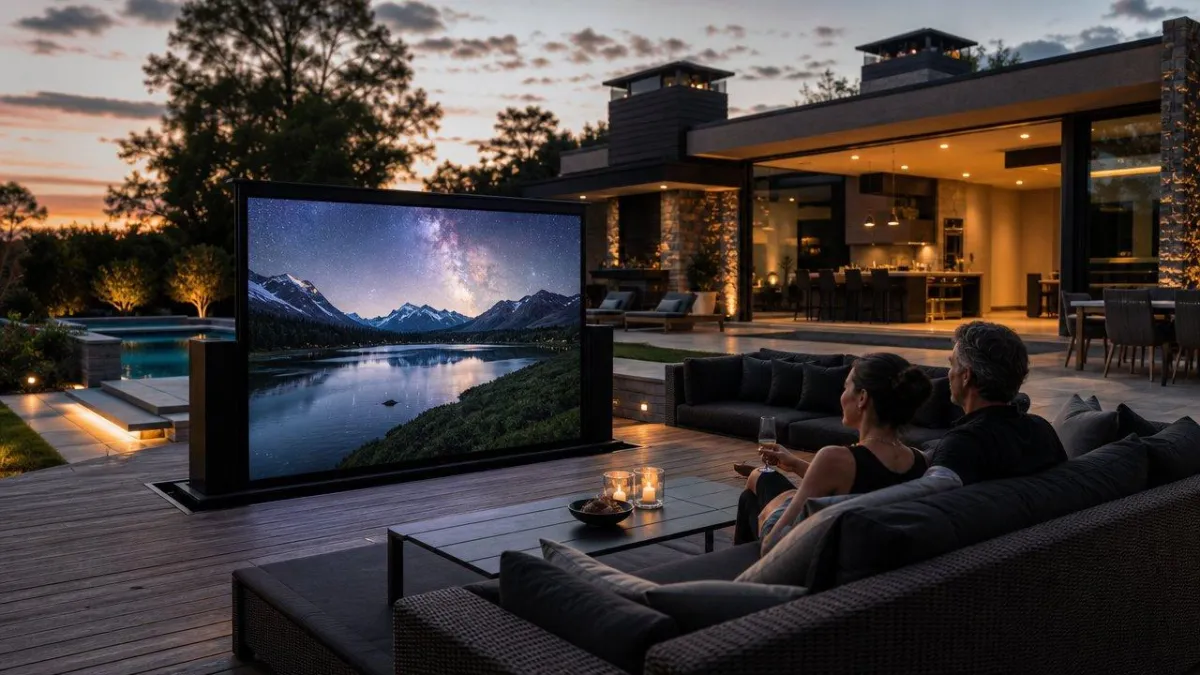
YOLO TV Rise Guide 2026: Pricing, Best Fit, and Luxury Outdoor TV Options
If you want a large outdoor screen without leaving a permanent TV in view, the YOLO TV Rise is often the better luxury solution. It is designed for homeowners who want a premium outdoor entertainment experience, but do not want a wall-mounted screen to dominate the architecture when the system is off. In most projects, the right choice comes down to how important concealment, screen size, installation style, and smart home integration are to the property. YOLO TV helped pioneer the large-format residential outdoor display category and now offers wall-mounted outdoor systems, Hidden Rise™ outdoor TV systems, Rise & Rotate™ solutions, portable Rise on the Go™ systems, and custom indoor large-format TVs for estates that want a more intentional display strategy.
Quick Answer
Can a residential command center still look elegant
Is Direct View LED better than a bank of premium monitors
A video wall without a proper control layer becomes frustrating fast
The Brains of the Operation Control System Integration
Is a control room video wall overkill for a residence
Design Principles for Your Command Center
A large property creates a coordination problem
Display Technology Comparison for Estate Control Rooms
Why Modern Estates Need a Central Command Center
Why seams matter more than most buyers expect
Is a premium estate display system overkill for a residence
Can a residential display space still look elegant
Is Direct View LED better than a bank of premium monitors or TVs
Architectural integration changes how the room feels
The room should support the experience, not distract from it
Design Principles for Luxury Display Spaces
The specifications that actually affect day-to-day use
Pixel pitch has to match the room
Can a hidden outdoor display still look elegant
Decoding the Specs for Flawless Visuals
Display Technology Comparison for Estate Spaces
Choosing Your Canvas Direct View LED vs Tiled LCD Walls
A premium display without a proper control layer becomes frustrating fast
Is the YOLO TV Rise better than a wall-mounted outdoor TV
A large property creates a visibility problem
Why Modern Estates Need a Smarter Display Strategy
Is a lift-based display system worth it for a residence
The room should support decisions, not distract from them
Design Principles for YOLO TV Rise Installations
What is the YOLO TV Rise?
The YOLO TV Rise is a hidden outdoor TV system that keeps a large-format screen concealed until you want to watch it.
The Brains of the Experience System Integration
Who is it for?
It is best for luxury homes, estates, and premium outdoor living spaces where a permanently visible TV would interrupt the design.
How does it compare to a wall-mounted outdoor TV?
A wall-mounted TV is simpler and more visible. A YOLO TV Rise is more architectural, more custom, and better suited to spaces where the screen should disappear when not in use.
Display Technology Comparison for Luxury Outdoor Spaces
What affects the investment range?
The biggest factors are screen size, installation complexity, concealment style, site conditions, and automation integration.
Is it worth it?
For buyers who care about clean sightlines, hidden technology, and a more refined outdoor experience, yes.
Why Modern Estates Need Hidden Display Solutions
Table of Contents
- What is the YOLO TV Rise and why do luxury homeowners choose it?
- How does YOLO TV compare across product types?
- What affects the price of a YOLO TV project?
- What specifications actually matter for daily use?
- How should a YOLO TV Rise installation be designed?
- How does smart home integration improve the experience?
- What can a real YOLO TV Rise project look like?
- Is a YOLO TV worth it?
- Best fit and not best fit
- What is the best next step before buying?
- Frequently Asked Questions
Why the YOLO TV Rise Changes the Conversation
Real-World Applications for Luxury Properties
Where can I read more about related residential display questions
What is the YOLO TV Rise and why do luxury homeowners choose it?
What should I prepare before talking with an integrator
Your Procurement and Installation Checklist
The YOLO TV Rise is a concealed outdoor TV system built for homeowners who want large-screen entertainment without leaving a large screen visible all day. In luxury homes, that matters because the display is not just a piece of electronics. It affects architecture, views, outdoor furniture planning, and the overall feel of the property.
The Brains Behind the Experience System Integration
Decoding the Specs for a Better Outdoor Experience
YOLO TV helped pioneer the large-format residential outdoor display category. Today, the company specializes in luxury outdoor LED TV systems, Hidden Rise™ outdoor TV systems, portable large-format displays, and custom indoor large-format TVs for homes that want something beyond a standard outdoor television.
Why concealment matters more than most buyers expect
The product family typically includes:
- Wall-mounted outdoor YOLO TV systems, for projects that want a visible fixed display.
- Hidden Rise™ outdoor TV systems, for spaces where the screen should disappear when not in use.
- Rise & Rotate™ systems, for layouts that need both concealment and directional flexibility.
- Portable Rise on the Go™ systems, for properties that want large-format viewing in more than one place.
- Indoor large-format LED TVs, for media rooms, club rooms, and statement interior spaces.
If your first priority is preserving the look of the space, the Rise category is usually where the conversation starts.
Why outdoor entertaining spaces create a design problem
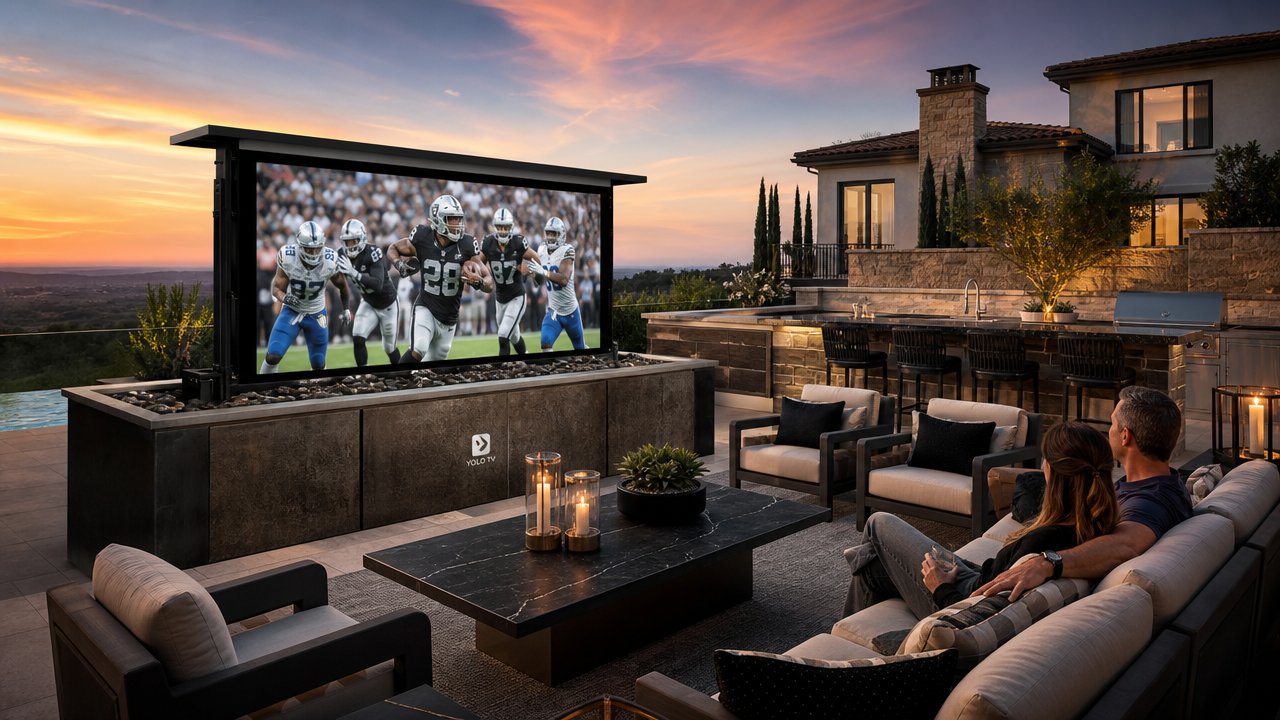
Many homeowners want a large outdoor screen, but they do not want to stare at it all day. That is the core design problem. A wall-mounted outdoor TV stays visible whether anyone is watching it or not. In a luxury setting, that can interrupt sightlines, compete with the pool, fireplace, or view, and make the space feel more commercial than residential.
The YOLO TV Rise solves that problem by hiding the display when it is not needed, then revealing it when the space shifts into entertainment mode. That makes it especially compelling in covered decks, pool terraces, outdoor kitchens, and premium lounge areas.
The broader display category has matured too. The LG control room overview notes that the falling price of LED chips has accelerated the adoption of fine-pitch Direct View LED (DVLED) solutions in control rooms, and that video wall brightness should be maintained between 500-700 nits for clear visibility in controlled environments.
Those are commercial observations, but one idea carries over cleanly to luxury residential work. Display performance should match how people actually use the space. Bigger and brighter are not automatically better if the screen feels out of scale with the architecture.
The best outdoor display solutions do not just show content well. They protect the look and feel of the property when the screen is off.
A well-planned YOLO TV project usually supports three goals:
- Architectural preservation: The screen stays hidden or intentionally placed, so sightlines stay cleaner.
- Large-screen entertainment: Sports, movies, and live events feel more immersive on a larger format.
- Daily usability: The system should feel simple to use and natural to live with.
For readers evaluating layout and coordination models, commercial security references can still be surprisingly useful. A practical example is this overview of a security operations center from ABCO Security Services Australia, which helps illustrate how centralized monitoring changes response speed and operator workflow.
What to Know
What to Know
- Large outdoor spaces need visual discipline: The more refined the property, the more obvious a permanently visible screen becomes.
- Concealment is part of the value: For many luxury buyers, hidden technology matters as much as image quality.
- A YOLO TV system is an architectural decision: Size, location, and installation style matter as much as the display itself.
If you are comparing options early, explore Outdoor LED TV sizing options and Hidden Rise™ TV systems before finalizing cabinetry, deck structure, and sightlines.
How does YOLO TV compare across product types?
YOLO TV is not one single installation style. The right product depends on whether you want the screen hidden, fixed, movable, or designed for indoor statement viewing.
Pricing comparison table
| YOLO TV product type | Best for | Visibility when not in use | Installation complexity | Typical investment range |
|---|---|---|---|---|
| Wall-mounted outdoor YOLO TV systems | Patios, secondary entertaining zones, simpler outdoor layouts | Always visible | Lower | Lower to mid investment range |
| Hidden Rise™ outdoor TV systems | Luxury terraces, pool decks, primary entertaining spaces | Hidden | High | Premium investment range |
| Rise & Rotate™ systems | Spaces that need flexible viewing angles and concealment | Hidden when lowered | High | Premium to upper premium investment range |
| Portable Rise on the Go™ systems | Event-driven properties, flexible outdoor viewing, multi-zone use | Stored or moved as needed | Moderate | Mid to premium investment range |
| Indoor large-format LED TVs | Media rooms, great rooms, club rooms, luxury interiors | Always visible or integrated into millwork | Moderate to high | Mid to premium investment range |
This table is best used as a planning guide, not a quote. Final pricing depends on installation style, site conditions, structural work, finishes, and control integration.
For visual examples, browse YOLO TV project spotlights and compare them to the way your own space will actually be used.
Where a fixed outdoor TV still makes sense
A fixed outdoor TV can still be the right answer in some spaces.
It usually makes sense when:
- the area is a secondary patio or casual zone
- concealment is not a priority
- the wall location is already natural for a screen
- the project does not require a custom reveal experience
The trade-off is that the screen becomes a permanent visual feature. In a primary entertaining area, many homeowners eventually wish it could disappear.
What affects the price of a YOLO TV project?
The price is shaped less by the screen alone and more by how the screen is integrated into the property. That is why two projects using a similar display can have very different investment ranges.
The biggest pricing drivers
Here are the factors that usually move the price most:
Screen size
Larger screens generally require more structure, more power planning, and more careful placement.Installation style
A wall-mounted outdoor system is typically simpler than a Hidden Rise™ system. A Rise & Rotate™ system can add more mechanical and design complexity.Site conditions
Deck construction, drainage, access, elevation changes, weather exposure, and local building conditions all influence labor and integration.Finish integration
Custom millwork, hardscape detailing, stone, metal, and concealment finishes can materially change the final investment range.Automation and control
Integrating the display with lighting, audio, and smart home scenes adds value, but it also adds programming scope.Audio and source equipment
A premium outdoor picture often needs matching outdoor audio, source distribution, and network planning.Service access
A beautiful installation still needs a smart maintenance plan. Easier access can reduce future disruption.
In simple terms, the screen is only one part of the project. The enclosure, reveal, controls, and surrounding construction often shape the result just as much.
Common mistakes
The biggest planning mistake is treating a YOLO TV Rise like a standard TV purchase instead of an architectural integration project.
- Choosing size before studying the space: The screen should match seating distance, deck scale, and focal points.
- Ignoring concealment details: Lift systems need early coordination with structure, drainage, finishes, and service access.
- Thinking only about the on-screen experience: In luxury homes, the off-screen look matters just as much.
- Separating AV decisions from design decisions: Display planning, finish detailing, power, and automation should be coordinated early. Review Outdoor LED TV sizing options before design details are finalized.
A useful rule is simple. If the space is meant to impress when the display is off as well as on, concealment deserves the same attention as the screen.
What specifications actually matter for daily use?
Most buyers do not need a long technical checklist. They need to know which specs actually affect whether the screen looks good and feels comfortable in real life.
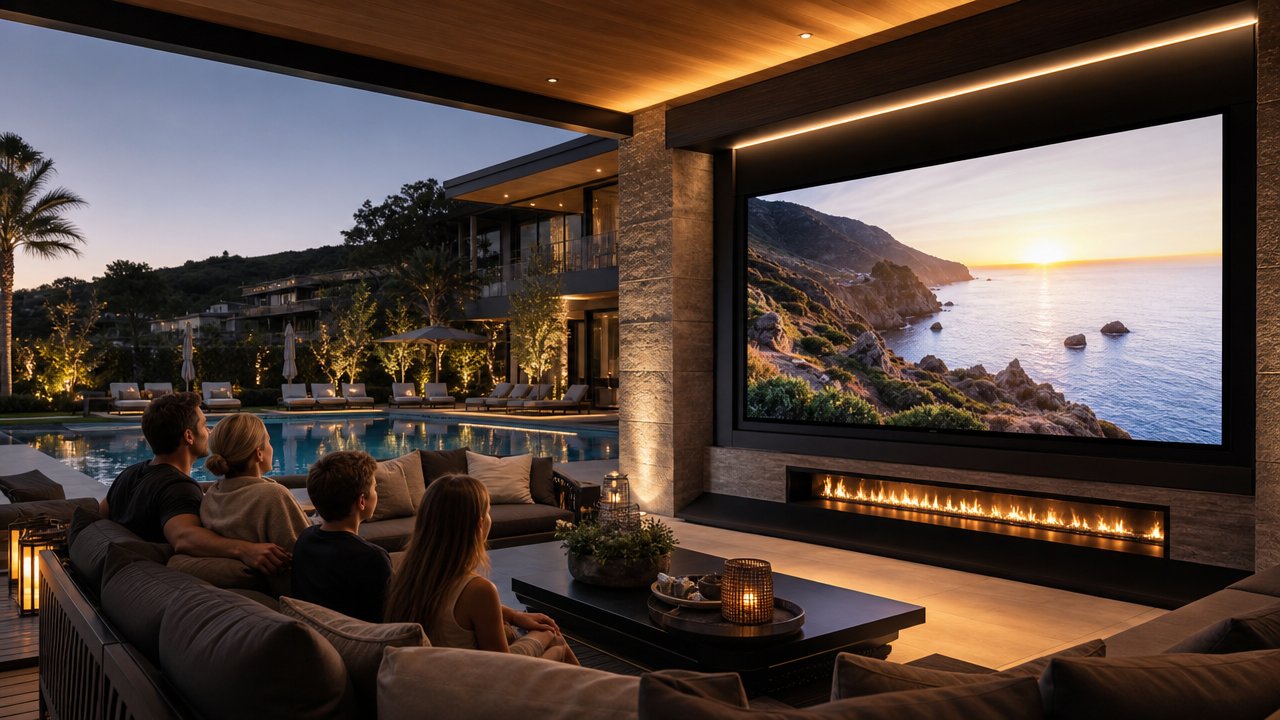
Screen size has to match the space
For large-format outdoor entertainment, size should be tied directly to where people gather and how the space is used. A covered deck with one main seating group has different needs from a pool terrace where viewers watch from several positions.
The Activu guide on DVLED in control rooms notes that operator viewing distance is typically 1 to 3 meters, and that fine pixel pitches such as 1.2mm to 1.8mm are required to avoid visible pixel structure. It also makes an important point that many buyers miss: the smallest available pitch is not automatically the best choice.
For residential buyers, pixel pitch simply means how tightly the tiny LEDs are packed together. A smaller number can look smoother up close, but it is only helpful if your viewing distance actually calls for it.
The specifications that actually affect daily use
A few practical criteria usually matter most:
- Brightness: This is how much light the screen can produce. More brightness helps in daylight, but too much can feel harsh at night.
- Clarity and resolution: These affect how sharp the picture looks, especially on a larger screen.
- Motion handling: Sports and live events look better when fast movement stays smooth. CreationLED's overview of refresh rates states that professional-grade LED video walls designed for control rooms typically feature refresh rates between 1920Hz and 3840Hz, with specialized systems exceeding 7680Hz to prevent motion blur and support accurate grayscale representation during live monitoring.
- Color fidelity: The picture should look rich and believable, not simply intense.
- Weather protection: If you see an IP rating, that is a short way of describing how well a product resists dust and water.
- Mechanical reliability: Hidden and rotating systems need excellent installation quality, not just strong screen performance.
One of the most useful ways to approach specs is to ask a simple question: what will the family actually notice from their favorite seats?
If you want to compare options beyond outdoor use, explore Indoor large-format TVs and review how the viewing distance changes the right screen choice.
Pro Tip
Pro Tip
Match the system to the best real gathering position, not the rendering. If the screen is being selected for a covered deck, pool terrace, or lounge area, real use positions should guide size, visibility, and reveal orientation.
How should a YOLO TV Rise installation be designed?
Technology selection is only half the work. The surrounding space determines whether the display feels elegant or intrusive.
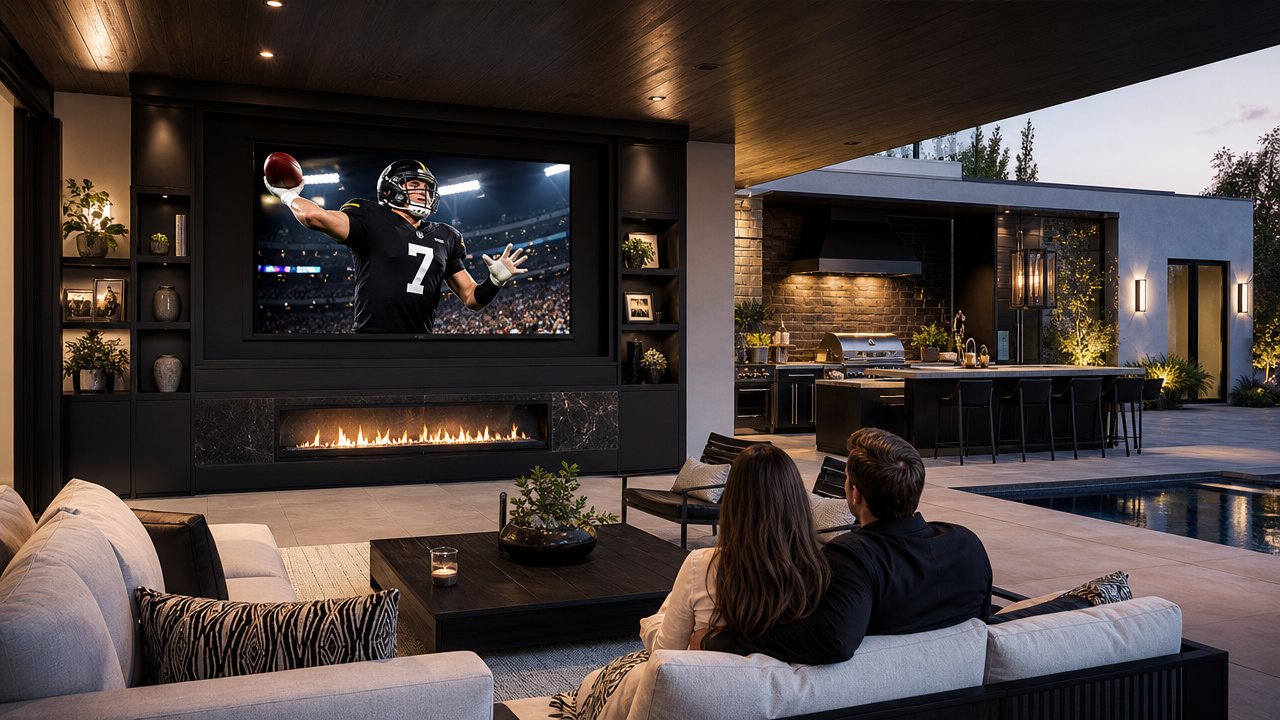
The space should support the experience, not distract from it
The best YOLO TV Rise installations feel calm when the screen is hidden and exciting when it appears. That usually comes from disciplined sightline planning, restrained materials, and close coordination between the display system and the outdoor environment.
Start with the visual priorities of the space. Is the area centered on a pool view, a fireplace, conversation seating, or a landscape vista? A hidden lift system works best when it protects those priorities instead of competing with them.
Acoustics matter too. Covered outdoor structures often create hard reflections that affect dialogue and music. Speaker placement and surface strategy should be considered at the same time as the screen location.
A practical low-light detail often gets overlooked during commissioning. The cited LED guidance from this grayscale dimming walkthrough notes that when indoor LED displays are dimmed below 40% intensity, selecting "grayscale" adjustment mode instead of "contrast" is critical to preserve grayscale fidelity, and that it requires a specific receiving card configuration for proper performance. In simple terms, a screen should still look nuanced and natural at night, not washed out or harsh.
Architectural integration changes how the space feels
The YOLO TV Rise can either disappear into the architecture or become a dramatic reveal feature. Both approaches can work.
Consider these design paths:
Deck-integrated concealment
- Best when the goal is a clean outdoor lounge with uninterrupted views.
- Works well where the screen can rise from a hidden structural enclosure.
Cabinet or hardscape integration
- Useful when the display needs a defined architectural home within the outdoor design.
- Pairs well with stone, metal, wood, and tailored landscape-adjacent detailing.
Hybrid entertainment zone
- Ideal where the area shifts between quiet outdoor living and event-style viewing.
- Often demands tighter coordination between integrator, builder, millworker, and automation programmer.
Early collaboration saves the project. Once framing, drainage, finish carpentry, and power are locked, the cost of changes rises quickly.
Architects and builders usually appreciate having CAD and mounting information early. It lets them plan structure, service access, concealment volume, ventilation strategy, and finish transitions before the display becomes a site problem.
How does smart home integration improve the experience?
A hidden display can be physically beautiful and still fail in daily use if the control layer is awkward. In residential work, that is one of the biggest differences between a cool feature and a system people genuinely use.
Why a hidden display still needs a proper control layer
The lift mechanism and screen are only the visible part of the system. Behind them, the project still needs an organized control environment that can handle source selection, lift behavior, audio routing, lighting scenes, and one-touch actions.
That may include streaming apps, live TV, sports packages, outdoor audio zones, weather services, landscape lighting scenes, pool controls, and selected property views when needed.
The best systems support custom presets that match real scenarios. A game-day preset might raise the screen, select the right source, cue outdoor speakers, and adjust lighting. A movie-night preset might soften the lighting and prioritize streaming. A party preset might keep music active before the display rises for a specific event.
This is also where broader estate systems matter. Integrators working on larger residential compounds often benefit from understanding adjacent disciplines such as credentialing and perimeter access. A resource like Adelaide access control systems is useful because it shows how access logic and monitoring architecture often need to be designed together, not in isolation.
What a refined user experience looks like
The most successful systems use familiar automation ecosystems and hide complexity behind them. Crestron, Savant, and Control4 are common examples in luxury residential work because they let a homeowner trigger scenes without needing to think like a technician.
Good integration usually includes:
- Preset modes: Tap once to raise the display and switch from casual listening to full video viewing.
- Simple control surfaces: Touchpanels, tablets, and wall keypads should use clear language, not engineering jargon.
- Coordinated environment control: Lighting, audio, and display behavior should feel like one experience.
- Consistent visual performance: Large outdoor content looks better when the display hardware and control programming are tuned together.
If the owner needs a cheat sheet to enjoy the space, the programming is not finished.
What can a real YOLO TV Rise project look like?
The best way to understand the product is to see how it fits a real property and a real family.
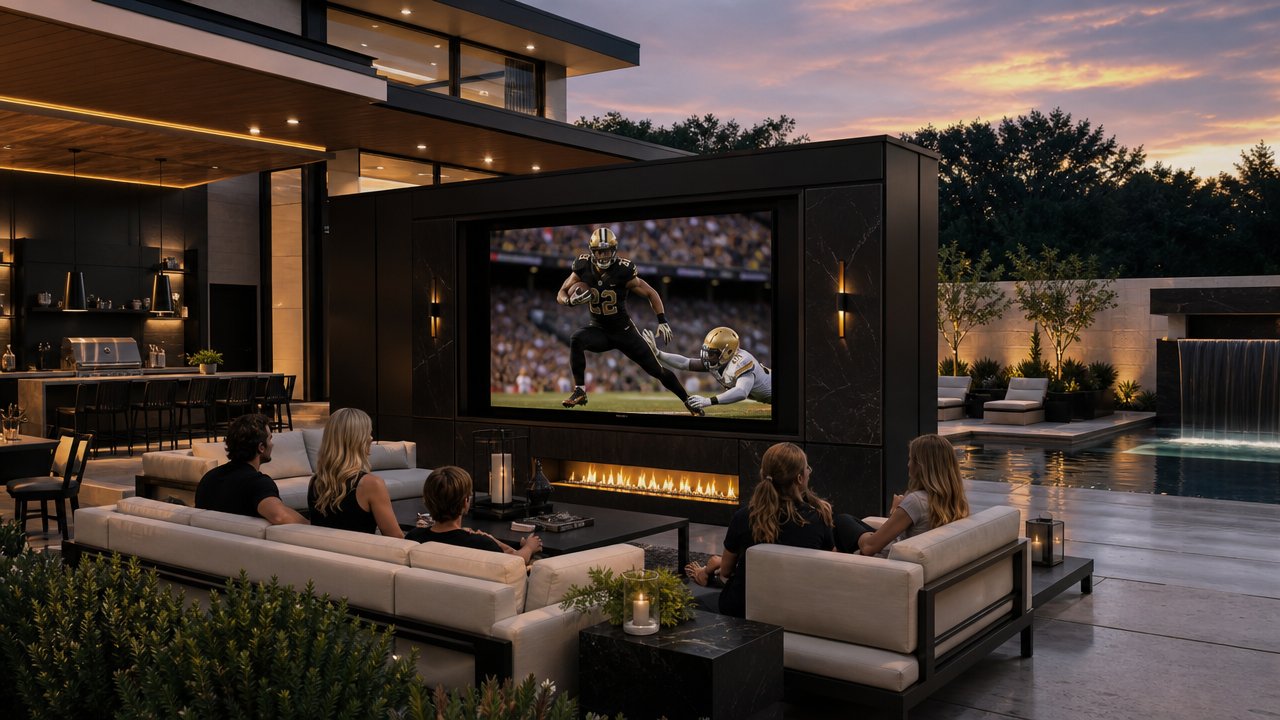
Nashville, Tennessee, YOLO TV Rise 158 installation
A strong example of the product's appeal is the YOLO TV Rise 158 installation in Nashville, Tennessee, where the display is integrated into the outdoor living area in a way that keeps the screen out of sight until it is needed.
That hidden effect was a major reason the homeowner chose this solution instead of a standard outdoor TV mounted under the deck. In the interview, the owner explained it simply: "You never see this. Right. That's really why I thought it was super cool." That reaction gets to the heart of why lift-based outdoor displays resonate in luxury residential design. They preserve the architecture when the screen is down, then create a dramatic reveal when the system rises.
The project also shows how outdoor display decisions are often driven by family use, not just technology. The homeowner described the space as the place "where all the kids are going to hang out as my kids grow up and stuff", which makes the installation feel less like a gadget and more like a long-term part of how the home will be enjoyed.
Performance mattered too. One of the strongest comments from the interview was about picture quality. The homeowner said, "I am super surprised on the clarity and the resolution. I did not think it would be that clear." That kind of response is especially important on a large-format outdoor display, where buyers often worry that brightness, weather protection, or scale will come at the cost of image sharpness.
For readers comparing a premium lift system to a conventional wall-mounted outdoor TV, this Nashville installation highlights three practical advantages:
- Hidden when not in use: The screen does not dominate the space full time.
- More memorable experience: The rise mechanism creates a reveal that feels custom and architectural.
- Large-screen impact with strong clarity: The homeowner specifically called out the resolution and overall image quality.
Scottsdale desert estate
A Scottsdale outdoor LED wall may get attention for entertainment, but its success usually comes from how well it fits the broader estate. On a desert property, the display often needs to support sports viewing, live events, and casual family use without overwhelming the architecture.
Desert properties create long sightlines and strong light transitions. People often move between bright exterior conditions and darker interior spaces. The display has to maintain clarity without feeling glaring after sunset.
Florida coastal compound
A Florida coastal outdoor TV installation has its own environmental requirements. Salt air, humidity, storms, and bright ambient light all shape what the display has to do. In those settings, buyers often want strong daylight visibility without an industrial look once the entertaining area is fully furnished.
Coastal properties also raise a subtler display issue: color trust. The Canbest discussion of LED walls for control rooms highlights a frequently overlooked challenge, noting that operators are often concerned about color space fidelity and accurate rendering of Rec.2020 or DCI-P3 for high-fidelity surveillance. Standard vendor marketing often skips over that issue. For luxury estates where image quality matters, that concern remains relevant. Buyers do not just want brightness. They want a picture that looks believable.
Texas equestrian estate
On a Texas equestrian estate, the display strategy often has to cover more ground. The property may need a large-format screen in a family gathering area, selective visibility from a club room or office, and a display solution that can support both events and everyday use.
Three patterns show up repeatedly across these properties:
- Large grounds reward intentional design: The more substantial the setting, the more valuable hidden technology becomes.
- Climate influences performance: Desert glare, coastal storm exposure, and Texas-scale acreage all shape what the display needs to do.
- High-end homes need visual discipline: The space cannot feel like a sports bar by accident. It has to perform without compromising the architecture.
Is a YOLO TV worth it?
Yes, if the goal is more than simply putting a screen outside.
A YOLO TV is usually worth it when the property values:
- clean sightlines
- a luxury entertainment reveal
- larger-format viewing than a standard outdoor TV
- custom integration with architecture and automation
- a display strategy that feels intentional, not added on
It may be less compelling if you only need a simple fixed screen on a casual patio. In that case, a traditional wall-mounted approach can be enough.
The right question is not just "How much does it cost?" It is "What experience do I want this space to deliver when the screen is on and when it is off?"
Best fit and not best fit
Best fit
- Luxury homes with architecturally important outdoor living space
- Pool terraces, covered decks, and entertaining areas with premium views
- Homeowners who want the screen hidden when not in use
- Projects that already include lighting, audio, and smart home integration
- Properties that want a statement-level entertainment feature
Not best fit
- Small casual patios where a visible TV is perfectly acceptable
- Projects with no realistic concealment path
- Buyers who want the simplest possible installation style
- Spaces where the architecture does not benefit from a hidden reveal
- Installations where premium integration is not a priority
What is the best next step before buying?
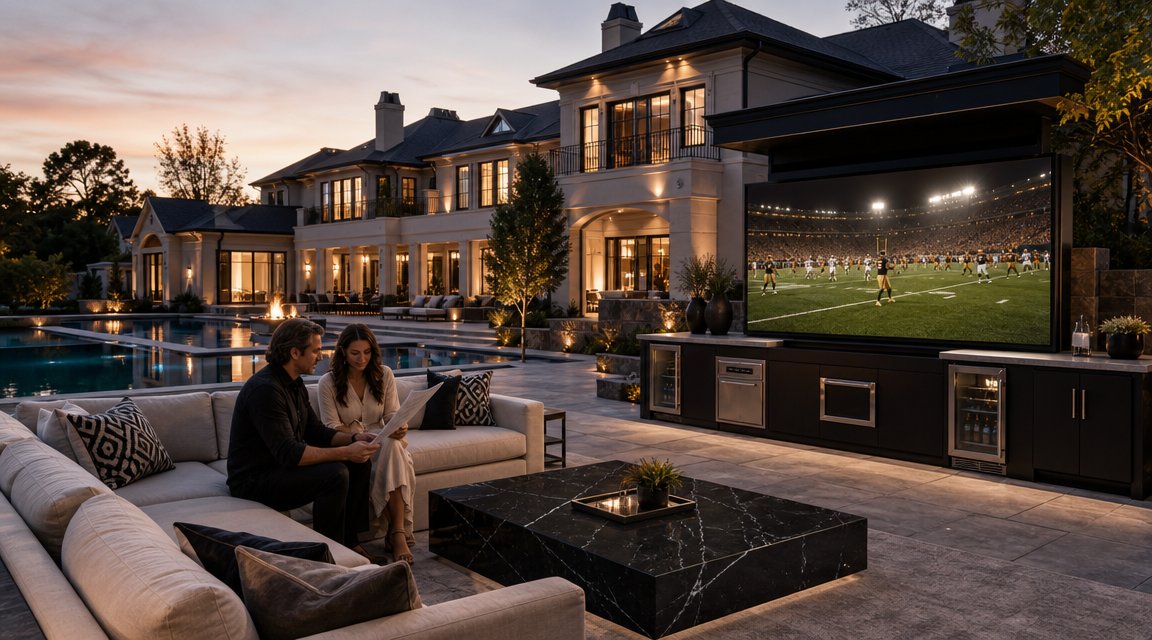
Start with photos, rough dimensions, and a short list of priorities. Think about where people sit, what they watch, and whether the screen should be visible all the time.
A serious YOLO TV project is a coordinated design exercise, not just a product selection. For a clearer sense of how that process is typically staged from inquiry through handoff, review the YOLO TV customer journey.
If you are ready to move forward, Start your YOLO TV design review. It is the fastest way to understand the right size, installation style, and likely investment range for your space.
Frequently Asked Questions
Is a lift-based display system worth it for a residence?
Yes. A lift-based display system is worth it when the outdoor space is visually important and the homeowner does not want a large screen visible all the time. The value is in both the picture and the ability to preserve the space when the system is not in use.
Is the YOLO TV Rise better than a wall-mounted outdoor TV?
Usually, yes, if the goal is a hidden luxury installation rather than a permanently visible screen. The YOLO TV Rise is especially compelling when the property prioritizes clean sightlines, custom design, and a more memorable entertainment reveal.
Can a hidden outdoor display still look elegant?
Yes. In many cases it looks more elegant because the screen is concealed when not needed. The strongest projects are designed so the technology supports the architecture instead of competing with it.
What affects the price of a YOLO TV most?
The biggest factors are screen size, installation style, site conditions, custom finish work, and smart home integration. A wall-mounted system and a Hidden Rise™ system can have very different investment ranges even at similar screen sizes.
What is the difference between Hidden Rise™, Rise & Rotate™, and Rise on the Go™?
Hidden Rise™ systems are designed to conceal the screen until it rises into view. Rise & Rotate™ systems add directional flexibility after the screen is raised. Rise on the Go™ systems prioritize portability so the display can be used in different areas as needed.
Are indoor large-format YOLO TVs only for media rooms?
No. Indoor large-format YOLO TVs can also work well in great rooms, club rooms, wellness spaces, and other interior areas where homeowners want a large statement display with a more custom feel than a standard television.
What should I prepare before talking with an integrator?
Bring site photos, rough dimensions, a seating plan, and any architectural drawings you already have. It also helps to note when the screen will be used most often and what kind of content matters most.
Where can I read more about related residential display questions?
A good place to continue is the YOLO TV FAQ library, especially if you are comparing indoor and outdoor display strategies for the same property.
Start Your YOLO TV Design Review. Share a few details about your space, and our team will help you understand the best size, installation style, and investment range for your project.
